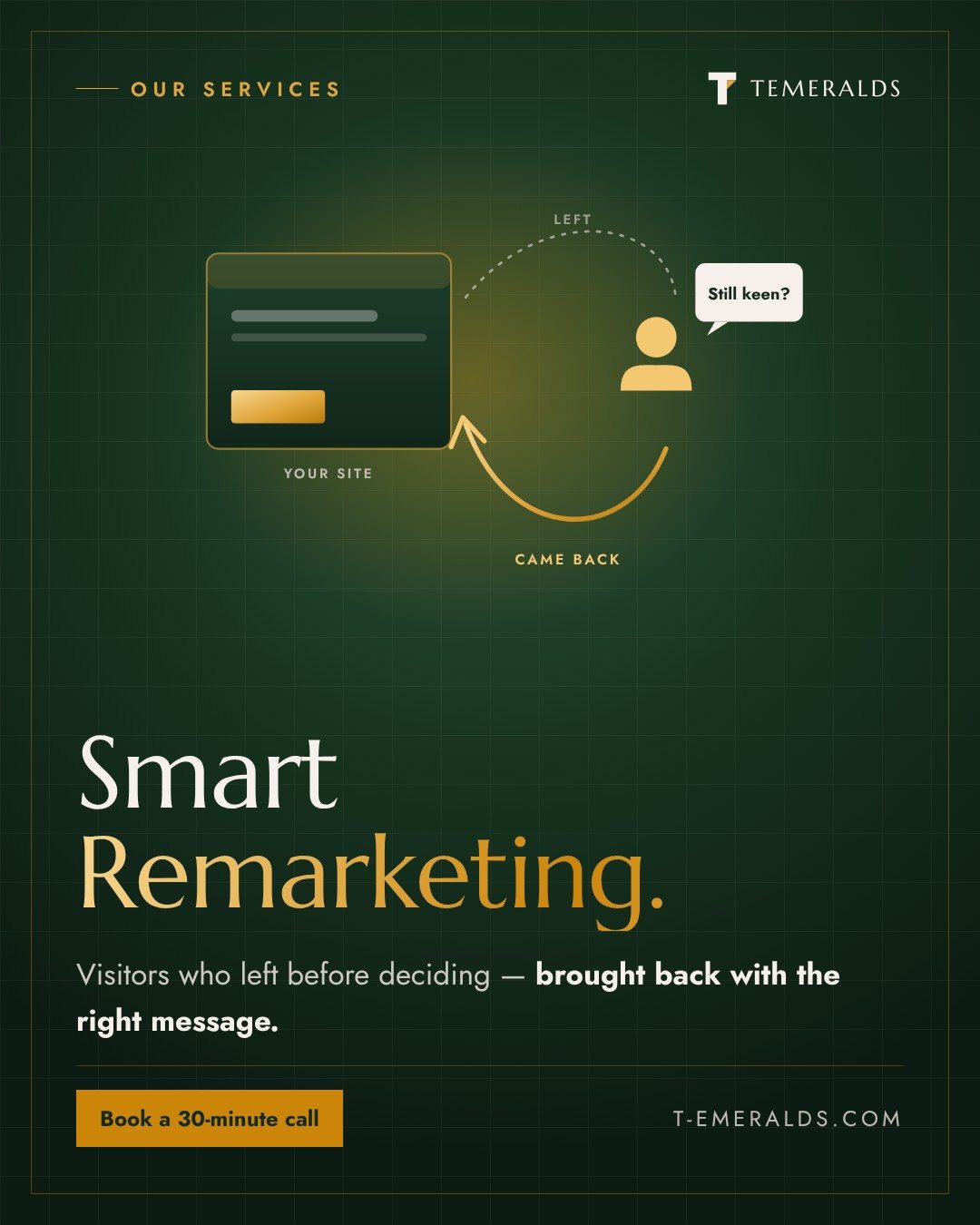
A reminder · not a chase
Remarketing and Retargeting
Most people who visit your site leave without acting. Remarketing brings back the ones who were close — and the difference between a reminder and a chase is three settings.
Segments by intent · Frequency caps · Buyers excluded

- 3segments minimum, never one list
- 1frequency cap per segment
- 4–7working days to launch
- 0uncapped campaigns
Check it yourself
- Google Partneragency status verified by Google
- Ads Transparencyevery campaign we run is listed publicly
- Case studiesFigures from the Google Ads interface, with client consent
- Office in New Cairo · most clients in Saudi Arabia · seven Arab markets
Google Ads
A message per segment
A visitor, a cart-adder and a checkout-starter are not the same — five segments, five messages, and buyers excluded.
TEMERALDS · Google Partner since 2017

The full film
Remarketing: bring them back
Most visitors leave without buying. Lists built by intent, the exact product they viewed, and a considered reminder — never chasing.
Figures and brand names in the film are illustrative; results differ from account to account.
See all our creative workVideo · 30 seconds
They were interested.
A considered reminder that brings visitors back at the right moment — never chasing.
See all our creative work
The method
What separates useful remarketing from irritating remarketing
Four settings, and almost every account gets at least two of them wrong.
- 01Segment by behaviourSomeone who read one page and someone who abandoned a full cart are different people. One list for both wastes the first and annoys the second.
- 02FrequencyThe same ad twenty times in a week does not persuade — it teaches people to ignore your brand. A cap is not optional.
- 03DurationA long decision cycle justifies a long window. A quick purchase does not, and chasing someone for ninety days after a five-minute decision is noise.
- 04MessageReminding someone of what they looked at works. Offering a discount to someone who was going to buy anyway pays them to do it.
How we build remarketing
- Behavioural segments — Cart abandoners, deep readers and bouncers treated separately.
- Frequency caps — Set per segment, so the reminder stays a reminder.
- Window per cycle — Matched to how long your buyer actually takes to decide.
- Dynamic remarketing — For stores: the product they viewed, not the catalogue.
- Exclusions — Existing customers removed unless there is a reason to reach them.
- Message per segment — Reassurance where there is hesitation, reminder where there is intent.
- Discount discipline — Used deliberately, so buyers do not learn to wait for it.
- Cross-channel — Search, display and YouTube coordinated rather than competing.
The difference
One list, or segments?
The default is one list for all visitors. It is also the reason remarketing has the reputation it has.
Common
Everyone in one list
- Bouncers and cart abandoners shown the same ad with the same frequency.
- No cap, so the same person sees the campaign dozens of times a week.
- A ninety-day window applied to a decision that takes an afternoon.
- An escalating discount, teaching buyers that waiting is rewarded.
What we do
Segments by behaviour
- Each segment given its own message and its own frequency.
- Caps set so the campaign reminds rather than pursues.
- A window drawn from your actual decision cycle.
- Discounts used in a defined window, then withdrawn.
Remarketing reaches the audience closest to a decision, which is precisely why it is the one most often burned by over-serving.
Google Ads
A reminder, not a chase
An ad that follows a visitor for two months drives them off — a frequency cap and a time window to fit the sector’s decision cycle.
TEMERALDS · Google Partner since 2017
Questions
What gets asked about remarketing
01Does it annoy people?
It does when the frequency is uncapped and the segment is undifferentiated. Capped and segmented, it is the highest-return audience in most accounts.
02How long should I follow someone?
As long as your buyer genuinely takes to decide, and no longer. We measure it from your data rather than applying a default.
03Should I offer a discount?
Sparingly and in a defined window. A permanent remarketing discount trains your best customers to wait for it.
04How soon should the first ad appear?
Within hours for a cart abandonment, days for a considered purchase. The window follows your decision cycle rather than a default setting.
05Can I exclude existing customers?
Yes, and usually we do — unless there is a genuine repeat-purchase reason to reach them. Paying to advertise to people who already bought is the quietest waste in most accounts.
06Does remarketing work for B2B?
Well, because the cycle is long and the audience is small. The caps matter more here: a procurement committee seeing your ad forty times reads as desperation rather than presence.
How we work — in writing
Four clauses that govern every engagement
Signed into a formal contract, and applied in every market we work in.
Full terms- Account
- Our accounts, not yours — and we never look inside yours.
- Payment
- Your card is linked to the account, and Google collects the click costs.
- Oversight
- The account is shown to you on a Google Meet call so you can verify spend and performance.
- Fees
- From 7,500 SAR a month, or the equivalent in your own currency.
Start
Discuss remarketing
Thirty minutes reviewing your market and your competitors, then a written proposal with scope and fees. No access to your account, and no commitment.
We reply within one working day
New Cairo, Egypt
Saudi Arabia · Egypt · UAE · Bahrain · Qatar · Oman · Kuwait · and worldwide